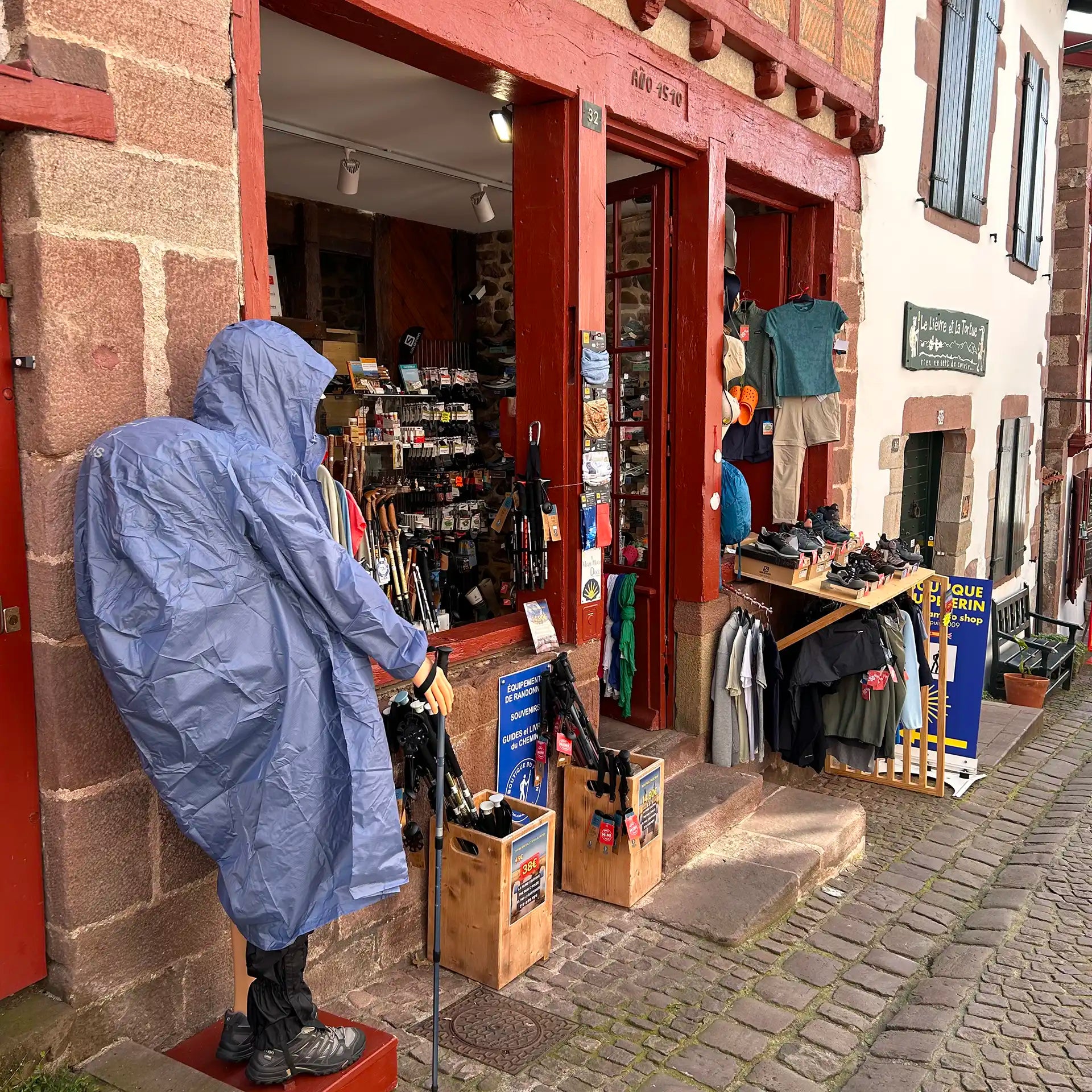
When preparing for your first Camino, rain is often an obsession.
"What if it rains every day?", "Do I need a cape, a jacket, trousers, gaiters?", "How do I keep my belongings dry?"
It's not about having all the equipment possible, but the right equipment, well combined.
Let's look together at the existing solutions, their advantages, their limitations, and above all how to make the right choices according to your walk .
1. Protect the essentials: the backpack and its contents
Backpack rain cover
This is the absolute foundation .
What is it for?
It wraps around your backpack and protects it from direct rain.
Benefits :
-
Lightweight
-
Compact
-
Easy to put on
-
Essential on the Camino
Boundaries :
-
It does not protect the wearer's back (water runs between you and the bag)
-
Ineffective in strong winds if it's a low-end model.
Pro tip : even with a cover, use waterproof bags or garbage bags inside . Double protection means peace of mind.
2. Protecting yourself: cape, poncho or waterproof jacket?
The poncho / rain cape
Very popular on the Camino de Santiago pilgrimage routes.
Benefits :
-
Covers both the walker and the bag
-
Highly breathable
-
Easy to put on
-
Ideal for continuous but moderate rainfall
Boundaries :
-
Unstable in strong winds
-
Less suitable for technical terrain
-
Sensation of being "caught by the wind"
Ideal for : the Camino Francés, long rolling stages, pilgrims who want simplicity and lightness.
The waterproof jacket (Gore-Tex® type membrane or equivalent)
It's the most versatile solution.
Benefits :
-
Good protection against rain and wind
-
Breathability (if the membrane is of good quality)
-
Can also be used as a windbreaker or lightweight thermal jacket
Boundaries :
-
The bag must be protected separately
-
The lower-end models quickly create a "sauna effect".
My shopping tip : choose a truly breathable jacket with an adjustable hood and ventilation zips. It's a worthwhile investment on many trails.
3. The lower body: often forgotten… and yet
Rain pants
We rarely take it with us… until the day we need it.
Benefits :
-
Keep your legs dry
-
Cuts the wind
-
Useful in the mountains or in cold weather
Boundaries :
-
Not very breathable
-
Often useless in a short rain shower
Take it with you if : you are walking in spring/autumn, on the GR10, or in exposed areas.
The gaiters
Often overlooked by beginners.
What are they used for?
-
They prevent water from running into the shoes
-
They protect against mud, pebbles and moisture.
Benefits :
-
Very effective in rain and on wet ground
-
Lightweight
Boundaries :
-
Useless on dry ground
-
Adjust carefully to avoid friction
An excellent complement to low-cut shoes.
4. Feet: the pilgrim's top priority
Waterproof socks
A real revolution for some walkers.
Benefits :
-
Keeps feet dry even in heavy rain
-
Useful if the shoes are soaked.
Boundaries :
-
Less breathable
-
For occasional use
Pilgrim's tip : only take it out on very wet days, not for daily use.
5. Should we take everything? Clearly not.
Here are some effective combinations depending on your profile:
Beginner on the Camino Francés
-
Bag cover
-
Poncho OR waterproof jacket
Regular walker / variable weather
-
Bag cover
-
Breathable waterproof jacket
-
gaiters
GR10 or mountainous areas
-
Bag cover
-
Waterproof jacket
-
Rain pants
In summary: walking in dry conditions is above all walking smart.
Rain is part of the journey.
On the Way of St. James, it's not her that ruins the experience , but the wrong equipment.
At La Boutique du Pèlerin in Saint-Jean-Pied-de-Port, our role is precisely to help you choose just what you need , depending on your route, the season and your way of walking .
Come see us, ask your questions, touch the products, try them out.
Good advice is often better than an overly heavy bag.
Buen Camino.