The Way of St. James
Walking to Santiago de Compostela is not simply following a marked route.
It is accepting to slow down , to carry less , and to move forward day after day, sometimes without knowing exactly what we are looking for — but feeling that the path has something to offer.
For over a thousand years, women and men have walked these paths. Some for faith, others for hardship, still others to find themselves. The Camino de Santiago is neither a sporting feat nor a simple hike: it is a long journey , as much an inner journey as a physical one.

Long walks:
an experience of the body and time
Long walks transform one's relationship with time.
The days are structured around the essentials: walking, eating, resting, starting again.
The body becomes a barometer.
We learn to listen to it, to respect it, to work within its limits.
This is not a performance.
It is a gentle, repeated, humble endurance .
Multi-column

What is the Way of St. James?
The Way of St. James refers to a set of pilgrimage routes leading to the Cathedral of Santiago de Compostela in Galicia (Spain), where the apostle Saint James is said to be buried.
Contrary to popular belief, there isn't just one route , but dozens of paths , crossing France, Spain, and Europe. They all converge on the same point, but each offers a different experience.
What unites the pilgrims is not so much the place of arrival as the way of getting there : on foot, slowly, with what one carries on one's back.

An old story, still alive
From the Middle Ages onwards, Compostela became one of the great Christian pilgrimages, on par with Rome or Jerusalem. The routes were structured, hospices appeared, and villages lived to the rhythm of the walkers.
But the Way never disappeared.
It has survived centuries, wars, and changes in beliefs. Even today, every year, hundreds of thousands of people take to the road — believers or not.
What has changed?
👉 The motivations.
What's left?
👉 Walking, effort, long periods of time.

Why the Way of St. James?
There is no universally good reason.
There are personal reasons, sometimes unclear at first.
- To experience a stripping away
- Going through a period of transition or questioning
- Reconnecting with your body through long walks
- To undertake a spiritual or symbolic pilgrimage
- Breaking free from the daily routine
- Experience simplicity
Many leave with a clear intention.
Many discover something else along the way.


Multi-column

Compostela today: an experience that remains relevant
The Camino de Santiago attracts very different profiles today:
- Young adults
- Retirees
- Athletes
- People in crisis
- Believers, agnostics, atheists
This blend is part of its contemporary identity.
The Way imposes nothing. It welcomes.

What the Way does not promise
He makes no promises:
- The illumination
- A miracle answer
- A guaranteed transformation
But it offers:
- Time
- Simplicity
- An honest confrontation with oneself
- A lived experience, not a theoretical one


Understanding the Path,
that's already a start to walking
Even before setting foot on a path, understanding what the Camino de Santiago entails allows you to leave feeling more just, lighter, more conscious.
This is not a trip like any other.
It is a path that is lived step by step , without certainty, but rarely without meaning.
Preparing for the Camino de Santiago

Material
- Choosing a suitable backpack
- Prioritize lightness
- Tried and tested shoes, never new
- Functional clothing, not superfluous.

Physically
- Getting used to walking for several days in a row
- Testing your equipment
- Learning to manage effort over time

Mentally
- Accepting discomfort
- Giving up control
- Leave room for the unexpected
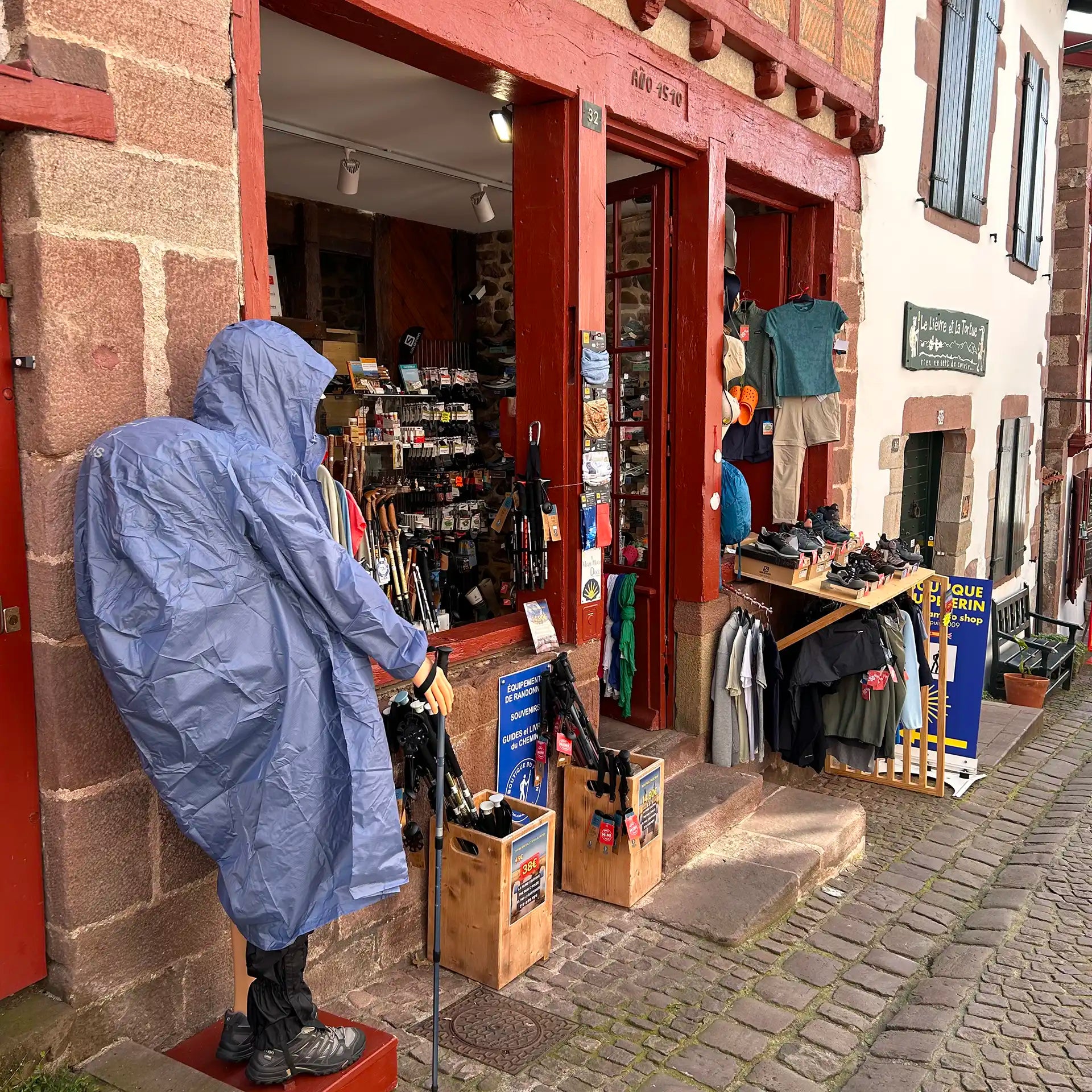
Pilgrim's Shop
32 Rue de la Citadelle, 64220 Saint-Jean-Pied-de-Port
Opening hours:
7 days a week | from 7 am to 7 pm